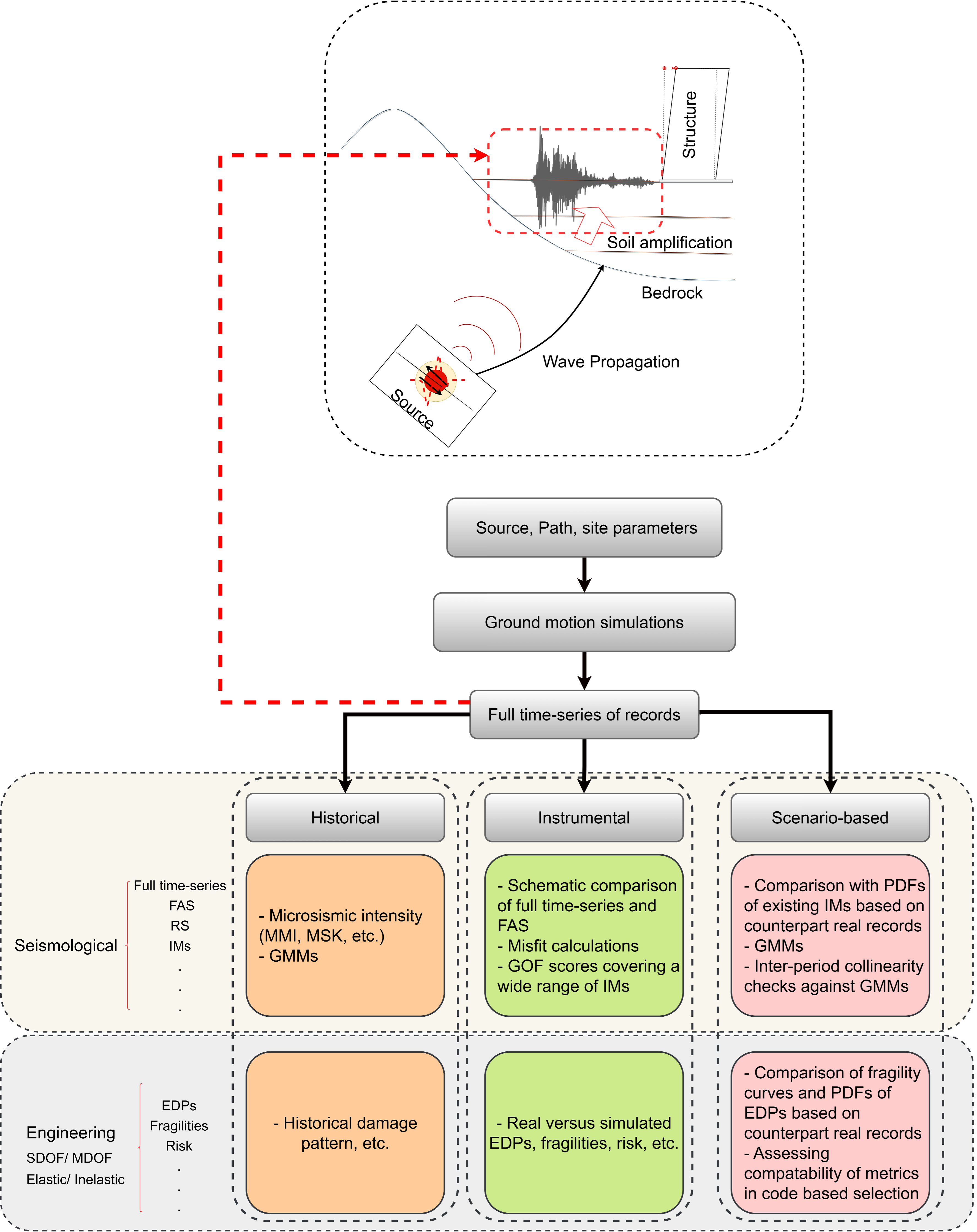
Advancements in numerical simulations of ground motions have evolved through diverse methodologies, each presenting distinct accuracies and challenges aiming at offering a realistic depiction of earthquake records, in addressing knowledge gaps arising from limited recordings, especially in the proximity of strong earthquake sources. Establishing confidence within the engineering community necessitates the validation of simulated accelerograms against recorded data from both seismological and engineering perspectives.
This paper endeavours to provide a comprehensive overview of simulation approaches, focusing on the datasets generated by the author, encompassing seismological and engineering validations across diverse regions with different tectonic characteristics, particularly emphasising the practicability of stochastic simulation approaches. Beyond seismological validations, the paper addresses engineering validation by examining demand parameters in both simple single-degree-of-freedom systems and more intricate multi-degree-of-freedom systems. Emphasising case-specific engineering demand validation, the paper illuminates the significant potential of ground motion simulations in bridging the gap between seismology and engineering challenges.
Keywords: Ground motion simulations, stochastic approaches, seismological validations, engineering demand validations, single-degree-of-freedom systems, multi-degree-of-freedom systems.


